Fleet driver communication becomes increasingly difficult when drivers spend long hours on the road while dispatchers, coordinators, customers, and operations teams continuously send updates, route changes, scheduling requests, and delivery instructions. The LeMi Apps Fleet Driver Communication system helps transportation companies maintain communication consistency without requiring drivers to manually respond while operating commercial vehicles.
Whether managing local delivery fleets, regional transportation teams, long-haul trucking operations, or field transportation services, communication automation helps reduce interruptions while maintaining operational responsiveness. Unlike personal driving safety workflows, fleet driver communication automation focuses on operational coordination, dispatch efficiency, driver availability awareness, and transportation workflow continuity.
Why Fleet Communication Becomes Difficult
Commercial drivers often receive constant communication throughout active driving sessions. This may include:
- dispatch updates
- delivery coordination
- scheduling changes
- route adjustments
- customer requests
- warehouse communication
- operational alerts
- supervisor check-ins
For many transportation companies, drivers feel pressure to:
- answer immediately
- explain delays
- confirm availability
- acknowledge dispatch messages
- respond during active driving
- manage communication while navigating traffic
The result can create:
- communication interruptions
- operational inefficiencies
- distracted driving behavior
- delayed dispatch responses
- inconsistent customer communication
- reduced driver focus
Fleet Driver Communication automation helps create more predictable communication workflows during active transportation operations.
Fleet Driver Communication Workflow Automation
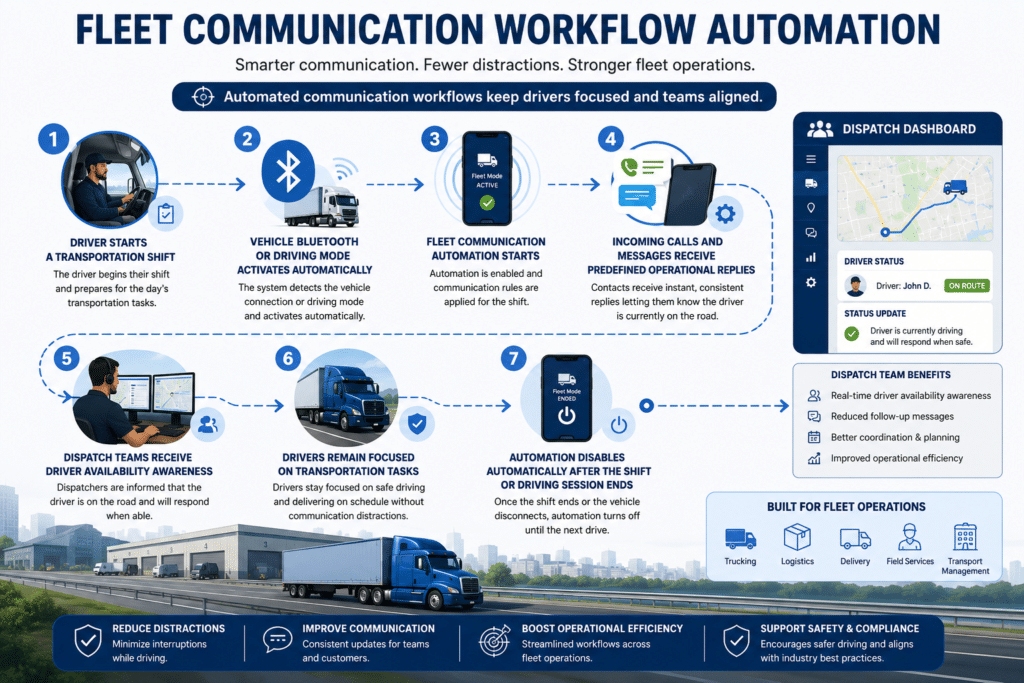 The system is designed around transportation communication workflows and commercial driving operations. Typical Workflow
- Driver starts a transportation shift
- Vehicle Bluetooth or driving mode activates automatically
- Fleet communication automation starts
- Incoming calls and messages receive predefined operational replies
- Dispatch teams receive driver availability awareness
- Drivers remain focused on transportation tasks
- Automation disables automatically after the shift or driving session ends
This creates a more structured communication layer across fleet operations.
Dispatch Communication without Constant Interruptions
Fleet operations rely heavily on dispatch coordination. However, constant communication interruptions can reduce driver focus during:
- highway driving
- urban deliveries
- loading operations
- navigation changes
- heavy traffic
- time-sensitive transportation routes
Automatic replies help dispatchers and operations teams understand that:
- the driver is currently operating a vehicle
- communication was received
- the driver may respond later when safe
- the transportation workflow is active
This helps reduce repeated communication attempts and improves operational clarity.
Maintain Communication Consistency Across Fleet Teams
One of the biggest challenges in transportation operations is maintaining communication consistency between multiple drivers and dispatch teams. Communication automation helps fleets create more standardized workflows by:
- maintaining consistent driver responses
- reducing communication gaps
- improving expectation management
- supporting transportation coordination
- reducing unnecessary interruptions
- helping teams stay operationally aligned
This is especially useful for:
- trucking companies
- logistics providers
- transportation departments
- courier fleets
- regional delivery operations
- field transportation teams
Text-to-Speech Support for Commercial Drivers
For transportation environments where message awareness is still necessary, Text-to-Speech functionality can read incoming communication aloud without requiring visual phone interaction. This may help drivers remain aware of:
- dispatch updates
- operational instructions
- route changes
- scheduling notifications
- coordination messages
without manually checking the device. The goal is not to increase communication volume. The goal is to reduce unsafe interaction while maintaining operational awareness during transportation workflows.
Best For
Trucking Companies Useful for long-haul and regional transportation operations that require ongoing dispatch coordination. Logistics Providers Supports operational communication during active transportation workflows and route management. Fleet Managers Helps maintain communication consistency across multiple active drivers and transportation teams. Commercial Delivery Operations Useful for businesses managing scheduled transportation and delivery fleets. Transportation Teams Supports structured communication between drivers, dispatchers, supervisors, and operations staff. Field Transportation Services Useful for mobile teams operating company vehicles throughout the workday.
Common Fleet Driver Communication Scenarios
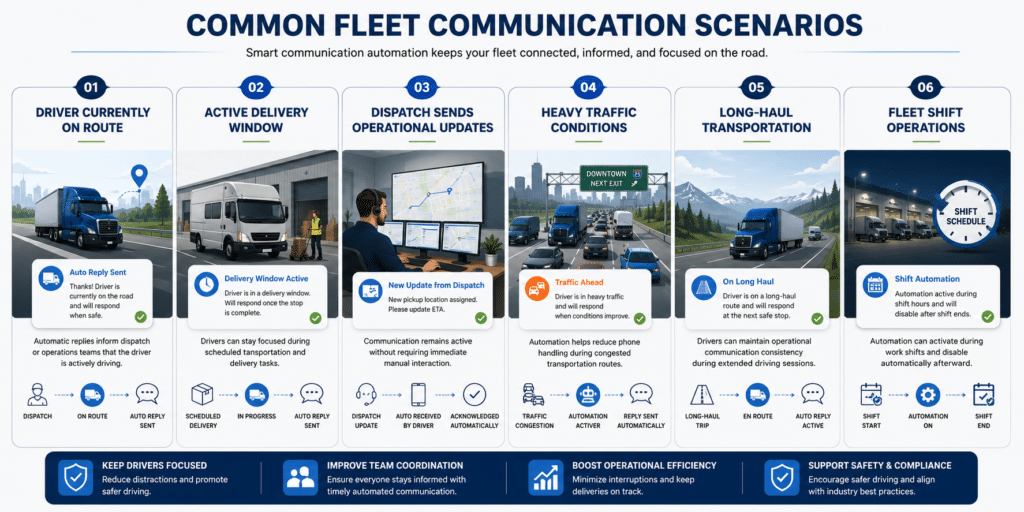 Driver Currently on Route Automatic replies inform dispatch or operations teams that the driver is actively driving. Active Delivery Window Drivers can stay focused during scheduled transportation and delivery tasks. Dispatch Sends Operational Updates Communication remains active without requiring immediate manual interaction. Heavy Traffic Conditions Automation helps reduce phone handling during congested transportation routes. Long-Haul Transportation Drivers can maintain operational communication consistency during extended driving sessions. Fleet Shift Operations Automation can activate during work shifts and disable automatically afterward.
Why Transportation Teams Use Fleet Communication Automation
Transportation companies commonly use communication automation to:
- reduce operational interruptions
- improve dispatch coordination
- maintain driver focus
- reduce communication pressure
- improve workflow consistency
- support transportation safety policies
- maintain response expectations
- improve operational awareness
- reduce unnecessary phone interaction
Fleet Communication & Transportation Operations
Modern transportation workflows depend heavily on constant communication between drivers, dispatchers, logistics coordinators, and operational teams. However, repeated communication interruptions during driving may reduce driver concentration and create workflow inefficiencies. Communication automation helps transportation companies maintain operational responsiveness while reducing unnecessary driver interaction with mobile devices during active transportation tasks.
Why Operational Communication Matters
Transportation teams often need to:
- coordinate deliveries
- update routes
- manage schedules
- monitor availability
- communicate delays
- maintain customer expectations
Fleet communication automation helps support these workflows while keeping communication more structured and predictable.
Transportation Workflow Benefits
Communication automation may help transportation operations:
- reduce repetitive communication attempts
- improve coordination awareness
- standardize driver availability messaging
- support dispatch efficiency
- reduce operational uncertainty
- maintain transportation communication continuity
Related Use Cases
Safe Driving Delivery Driver Communication Bluetooth Triggered Auto Reply Text-to-Speech for Driving Safe Driving Auto Reply — Hands-Free SMS & Calls for Android
Frequently Asked Questions
Can fleet drivers activate communication automation automatically?
Yes. Fleet communication automation can activate automatically through Bluetooth-triggered driving workflows.Is this useful for trucking companies?
Yes. Transportation companies and trucking operations can use communication automation to improve operational coordination during active driving sessions.Can dispatch teams still contact drivers?
Yes. The system helps automate responses and communication awareness while drivers remain focused on transportation tasks.Can incoming messages be read aloud?
Yes. Text-to-Speech functionality can read incoming communication aloud without requiring visual interaction.Is Fleet Driver Communication designed for business operations?
Yes. This use case focuses specifically on transportation teams, logistics operations, dispatch coordination, and commercial fleet workflows.Can drivers use custom auto reply messages?
Yes. Transportation teams can configure customized operational responses depending on workflow needs.Transportation Communication & Driver Focus
Commercial transportation environments involve continuous operational communication between drivers, dispatch teams, logistics coordinators, and transportation managers throughout the workday. According to the Federal Motor Carrier Safety Administration (FMCSA) commercial transportation safety depends heavily on maintaining driver focus and reducing unnecessary distractions during vehicle operation. Drivers may regularly receive:
- dispatch instructions
- customer updates
- scheduling requests
- route coordination messages
- transportation status inquiries
- operational alerts
Managing this communication manually while operating commercial vehicles can interrupt transportation workflows and reduce driver concentration during active driving sessions. The Occupational Safety and Health Administration (OSHA) identifies distracted driving as an important workplace driving safety concern for employers and transportation operations. Modern logistics and transportation companies increasingly rely on structured communication systems, dispatch coordination, and operational workflow efficiency. Research and industry analysis from the American Transportation Research Institute (ATRI) continues to highlight the importance of transportation workflow optimization and commercial driver operational safety.
Key Operational Considerations
- Commercial drivers often manage continuous communication during active transportation tasks
- Repeated message interruptions may reduce concentration during driving
- Operational communication expectations continue increasing across logistics environments
- Hands-free communication workflows may help reduce visual phone interaction
- Structured communication automation can improve transportation coordination consistency
Why Fleet Communication Automation Matters
Transportation companies increasingly rely on fast operational coordination. Fleet Driver Communication helps:
- maintain communication continuity
- improve dispatch awareness
- reduce repeated interruptions
- support safer transportation workflows
- improve operational consistency across teams
Improve Fleet Communication without Increasing Driver Distractions
Support transportation coordination, reduce communication interruptions, and maintain operational responsiveness across fleet operations. Improve Fleet Communication Explore Transportation Automation