Auto Reply vs Call Forwarding is a common comparison for businesses and professionals deciding how to manage incoming calls when they cannot answer immediately. When someone calls and you cannot answer, two common options are call forwarding and automatic replies.
Call forwarding redirects the call to another number. Automatic replies send a message back when you are unavailable, busy, driving, in a meeting, or outside business hours.
Both can help manage incoming calls, but they solve different communication problems.
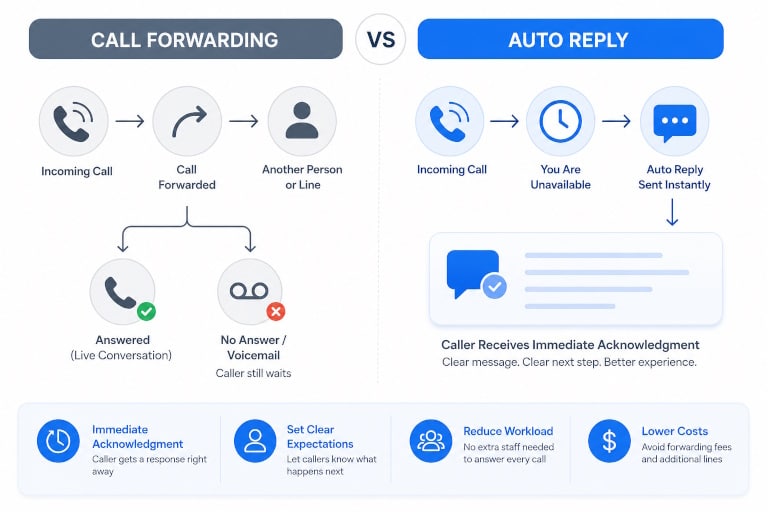
Quick Answer
Use call forwarding when another person is available to answer the call live.
Use auto reply when you want to acknowledge the caller immediately, explain your availability, and set clear response expectations without needing extra staff.
For small businesses, independent professionals, mobile workers, and after-hours communication, an automatic reply can often be more practical than forwarding every call.
What Is Call Forwarding?
Call forwarding is a phone feature that redirects incoming calls from one number to another number. For example, a business owner may forward calls from a main number to a mobile phone, assistant, office line, or answering service.
This can be useful when someone else is ready to answer. But if the forwarded number is also unavailable, the caller may still reach voicemail or receive no useful response. See AT&T call forwarding support guide.
What Is an Automatic Reply?
An automatic reply sends a predefined SMS or message response when you cannot answer directly.
With SMS Auto Reply & Autoresponder, users can create scheduled replies, after-hours replies, contact-based replies, and missed call auto replies through the website version.
Instead of sending the caller to another phone, auto reply tells the person what is happening and what to expect next.
Example:
“Thanks for calling. I’m unavailable right now, but I received your message and will get back to you as soon as possible.”
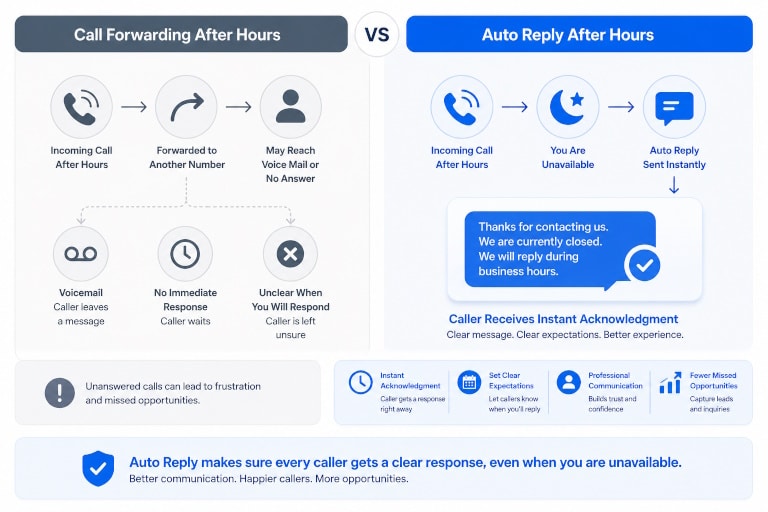
Auto Reply vs Call Forwarding: Main Difference
Call forwarding tries to move the conversation somewhere else.
Auto reply manages the expectation immediately.
That difference matters because many callers do not only want a live answer. They want confirmation that their call was received and that someone will respond.
Availability
Call forwarding depends on another person or device being available.
Auto reply works when you are unavailable, in a meeting, driving, sleeping, helping another customer, or outside working hours.
For availability-based communication, auto reply is often more flexible because it does not require another live person to answer. See also Meetings and Unavailable Times Auto Reply.
Staffing
Call forwarding can work well for larger teams with receptionists, assistants, call centers, or rotating staff.
For solo professionals and small businesses, call forwarding can create another problem: someone still has to answer the forwarded call.
Auto reply helps reduce the need for extra staffing by sending an instant response automatically.
This is useful for:
- small business owners
- service providers
- consultants
- drivers
- real estate agents
- home service professionals
- health and wellness providers
- anyone who cannot answer every call live
After-Hours Communication
Call forwarding after hours may send calls to a personal phone, another employee, voicemail, or an answering service.
Auto reply can send a clear after-hours message instead:
“Thanks for contacting us. We are currently closed. We will reply during business hours.”
This keeps communication professional without requiring someone to answer calls at night, on weekends, or during holidays.
Costs
Call forwarding may be included in some phone plans, but business use can involve extra costs when forwarding to staff, receptionists, answering services, or additional phone lines.
Auto reply can reduce dependency on live call handling by automating the first response.
External reference: the FCC notes that phone bills may include feature charges for services such as call forwarding and voicemail. FCC guide to understanding your telephone bill.
Customer Experience
Call forwarding can create a good experience when the forwarded call is answered quickly.
But it can also create friction:
- the caller may wait longer
- the call may be forwarded to someone unprepared
- the call may still go unanswered
- the customer may not know when to expect a response
Auto reply creates immediate acknowledgment. Even when no one can answer, the customer receives a clear message.
That can improve confidence, reduce frustration, and prevent the feeling of being ignored.
Response Expectations
Call forwarding focuses on connection.
Auto reply focuses on expectation management.
For many business situations, expectation management is critical. A fast message can tell the caller:
- you received the call
- you are currently unavailable
- when you will respond
- what they should do next
- whether there is an alternative contact method
This is especially useful for lead response, after-hours inquiries, appointment requests, and service calls. See also Stop Missed Calls From Becoming Lost Sales.
When Call Forwarding Is Better
Call forwarding is better when:
- another person is ready to answer live
- the call is urgent
- the business has a receptionist or call center
- the caller needs a real-time conversation
- the team can handle forwarded calls consistently
When Auto Reply Is Better
Auto reply is better when:
- you cannot answer every call
- you work alone or with a small team
- you need after-hours communication
- you want instant acknowledgment
- you want to reduce interruptions
- you want to set response expectations
- you want a written follow-up message
- you want missed calls to receive an automatic response
Best Option for Small Businesses
For many small businesses, the best setup is not always call forwarding or auto reply alone. A practical approach is:
Use call forwarding when someone is available to answer.
Use auto reply when nobody is available, when the business is closed, or when calls are missed.
That gives customers both options: live help when possible and instant acknowledgment when live help is not available.
Turn Missed Calls into Clear Next Steps
Do not leave callers guessing.
Use automatic replies to acknowledge missed calls, explain your availability, and set clear response expectations.
Try SMS Auto Reply & Autoresponder
FAQ
What is the difference between auto reply vs call forwarding?
Call forwarding redirects an incoming call to another number. Auto reply sends an automatic message when you cannot answer. Call forwarding depends on someone answering live, while auto reply gives the caller an immediate written response.
Is auto reply better than call forwarding?
Auto reply is better when you want to acknowledge missed calls, manage availability, reduce interruptions, or handle after-hours communication. Call forwarding is better when another person is available to answer the call in real time.
Can call forwarding replace an automatic reply?
Not always. Call forwarding only moves the call to another number. If nobody answers the forwarded call, the customer may still receive no clear response. Auto reply helps explain what happens next.
Is call forwarding good for after-hours calls?
Call forwarding can work after hours if someone is available to answer. If nobody is available, an after-hours auto reply may create a better customer experience by confirming that the message was received and setting expectations.
Does auto reply help with missed calls?
Yes. Auto reply can help missed callers receive an immediate response instead of waiting, guessing, or leaving voicemail. This is useful for businesses, service providers, and professionals who cannot answer every call.
Should a small business use call forwarding or auto reply?
A small business can use both. Call forwarding is useful during business hours when someone can answer. Auto reply is useful when calls are missed, staff are unavailable, or the business is closed.
Does auto reply reduce the need for extra staff?
Auto reply does not replace staff for complex conversations, but it can reduce the need for someone to manually respond to every missed call or after-hours inquiry.
Why is auto reply useful for customer experience?
Auto reply gives callers instant acknowledgment. It tells them their call was noticed and helps them understand when they can expect a response.