When you cannot answer a call, you still need a reliable way to handle it. In this Auto Reply vs Voicemail comparison, the key question is simple: what creates a better experience for the caller and a better outcome for you or your business?
Voicemail and automatic SMS replies both help with missed calls, but they work very differently. Voicemail lets callers leave a message and wait for a callback. Auto reply sends an immediate text acknowledgment, helping set expectations right away.
For personal use, voicemail may be enough. For business communication, after-hours response, customer inquiries, and lead capture, auto reply often offers a faster and more convenient way to keep communication moving.
What Is Voicemail?
Voicemail is a traditional call-handling feature that records a caller’s message when you do not answer.
It is useful when the caller wants to explain something in detail, leave a voice message, or provide context that may be easier to speak than type. Modern voicemail systems may also support transcription, including features such as Apple Live Voicemail and Google Voice voicemail transcripts.
What Is an Auto Reply?
An auto reply sends an automatic SMS response when you miss a call, receive a text, or become unavailable during a specific situation.
Instead of waiting for the caller to leave a voicemail, the app immediately sends a message such as:
“Thanks for calling. I’m unavailable right now, but I received your call and will get back to you soon.”
With SMS Auto Reply & Autoresponder, users can create automatic replies for busy times, meetings, sleep hours, after-hours communication, and other unavailable moments.
Auto Reply vs Voicemail: The Core Difference
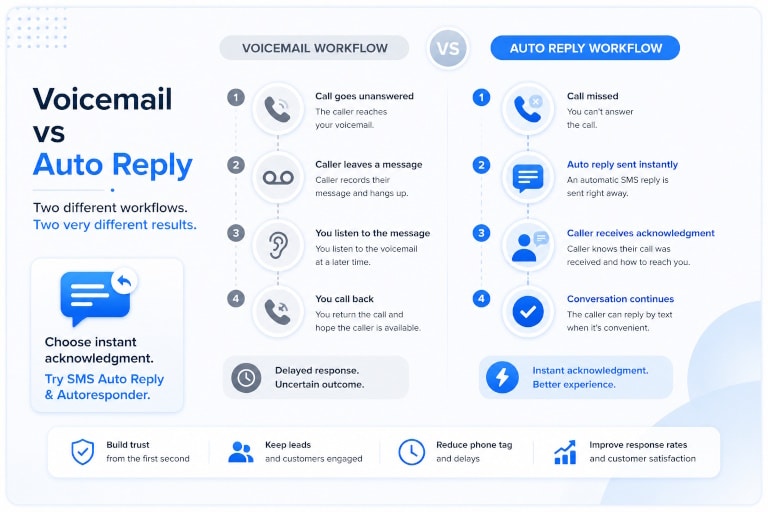
Voicemail is passive. It waits for the caller to take action.
Auto reply is active. It immediately confirms that the call was noticed.
That difference matters because many callers do not want to leave voicemail anymore. They may hang up, search for another provider, or expect a faster text-based response.
Response Speed
Voicemail depends on three steps: the caller leaves a message, you listen to it, and then you call back.
Auto reply reduces that delay by sending an immediate SMS confirmation. This is especially useful for businesses, service providers, consultants, drivers, field workers, and anyone who receives important calls while unavailable.
Convenience for the Caller
Voicemail asks the caller to record a message.
Auto reply gives the caller instant confirmation without requiring them to speak, wait for the beep, or explain everything by voice. The caller can continue the conversation by text, which is often easier in busy or public environments.
Customer Expectations
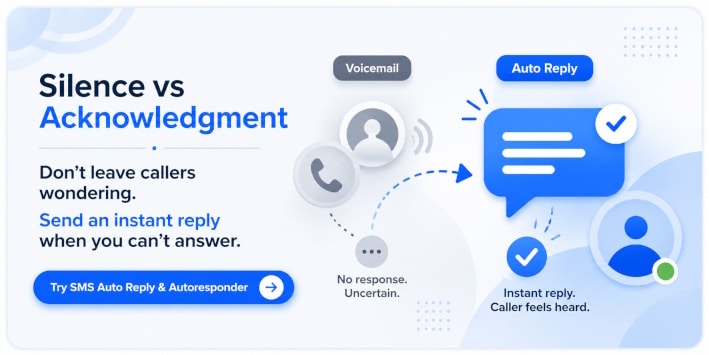
Customers increasingly expect quick acknowledgment. A missed call with no response can feel like silence.
Auto reply helps close that communication gap. Even a short message can tell the customer that the business is active, the call was received, and a response is coming.
For broader consumer protection and communication rules, see the FCC guide on unwanted robocalls and texts.
Auto Reply vs Voicemail: Business Communication
Voicemail can work for detailed messages, but it is not always the best first response for business calls.
Auto reply is better when the goal is to keep communication moving. It can confirm availability, explain response times, send business hours, direct people to a booking page, or ask the caller to reply with details.
Lead Capture
Voicemail can capture a message only if the caller chooses to leave one.
Auto reply can help capture intent even when the caller hangs up. A quick SMS response can invite the caller to reply with what they need, request a quote, confirm interest, or share details.
For service businesses and sales teams, auto reply can support business lead response by turning missed calls into active text conversations.
For lead-driven businesses, this can be the difference between a silent missed call and a continued conversation.
Callback Rates
Voicemail often creates delay. The caller may not leave a message, may not answer when you call back, or may have already contacted a competitor.
Auto reply can improve the callback experience because it creates an immediate text thread. The caller has a clear communication path and can respond when convenient.
Accessibility
Voicemail is voice-based. That can be useful for some callers but inconvenient for others.
Auto reply is text-based, which may be easier for callers who are in a noisy place, unable to speak, hard of hearing, in a meeting, or simply prefer written communication.
The best approach is not always one or the other. Many users keep voicemail for detailed voice messages and use auto reply for faster acknowledgment.
When Voicemail Is Better
Voicemail is a good fit when:
- The caller needs to leave a detailed spoken message
- The call is personal or non-urgent
- A recorded voice message is useful
- You do not need an immediate SMS acknowledgment
- Your phone system already handles call routing well
When Auto Reply Is Better
Auto reply is a better fit when:
- Missed calls may become lost leads
- Customers expect fast acknowledgment
- You want to reduce phone tag
- You need after-hours communication
- You want to send a clear reply while unavailable
- You want callers to continue by text
- You need a simple way to manage repeated missed-call situations
Best Option for Businesses
For most businesses, voicemail alone is not enough.
Voicemail records the missed opportunity. Auto reply helps keep the opportunity alive.
If a customer calls and you cannot answer, an automatic SMS can immediately confirm that the call was received, explain when you will respond, and invite the customer to send details by text.
That makes auto reply especially useful for local services, real estate agents, consultants, repair professionals, healthcare-adjacent service providers, drivers, freelancers, and small business owners.
If missed calls directly affect revenue, you may also want to see how to stop missed calls from becoming lost sales with automatic replies.
Recommended Solution
Use SMS Auto Reply if you want automatic replies for missed calls, SMS messages, meetings and unavailable times, after-hours communication, and customer inquiries.
Use voicemail as a backup for callers who prefer to leave a spoken message.
Turn Missed Calls Into Instant Acknowledgment
Do not let missed calls feel ignored. Send an automatic SMS reply when you are busy, unavailable, or outside business hours.
Try SMS Auto Reply & Autoresponder
FAQ
Auto Reply vs Voicemail: which is better for missed calls?
Auto reply is usually better when you want to acknowledge missed calls immediately and keep communication moving by text. Voicemail is better when the caller needs to leave a detailed spoken message.
What is the difference between auto reply and voicemail?
Voicemail records a voice message after a missed or unanswered call. Auto reply sends an automatic SMS response right away, letting the caller know the call was received and setting expectations for a follow-up.
Is auto reply better than voicemail for business communication?
For many businesses, yes. Auto reply can acknowledge customer calls instantly, reduce silence after missed calls, and encourage callers to continue by text. Voicemail can still be useful as a backup for callers who prefer to leave a spoken message.
Can auto reply replace voicemail?
Auto reply can replace voicemail for many everyday missed-call situations, especially when speed and convenience matter. However, voicemail is still useful when callers need to leave detailed information verbally.
Why do businesses use auto reply instead of voicemail?
Businesses use auto reply because it provides immediate acknowledgment, helps manage customer expectations, supports after-hours communication, and can turn missed calls into text conversations instead of dead ends.
Does voicemail help with lead capture?
Voicemail can help only if the caller chooses to leave a message. Auto reply can be more effective for lead capture because it sends an instant response and gives the caller an easy way to reply by text.
Can I use both auto reply and voicemail together?
Yes. Many people use auto reply for instant SMS acknowledgment and keep voicemail as a backup for callers who want to leave a detailed voice message.